Boundaries are a necessary element in any healthy relationship as they allow us to preserve…
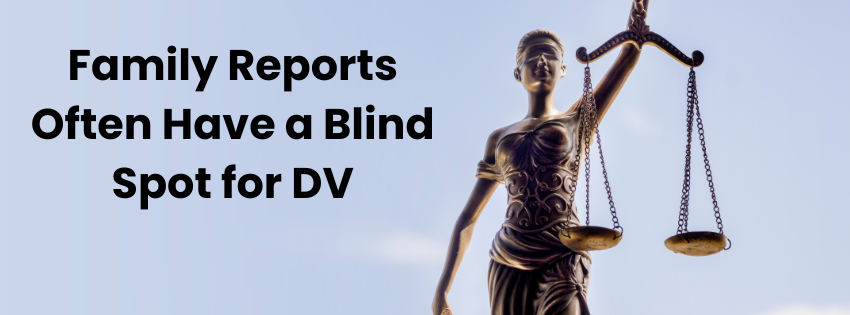
“Best Interests” vs. Lived Reality: How Family Reports Can Fail Victims of Family Violence
In my practice, I frequently work with mothers who find themselves in the family court system, navigating settlement and child arrangements after separating from an abusive partner. This is usually a difficult, drawn-out process and, quite often, an inevitable component is a family report assessment that makes recommendations for child arrangements. I’ll be honest, what I have seen and heard in some of these reports has been both disconcerting and deeply upsetting for me, both personally and professionally.
Initially, I thought such reports might be exceptions or rare occurrences. But as I’ve learned more over the years through practical experience and doing personal research in the Family and Domestic Violence (FDV) space, I’ve realised that sadly, they are not. I was keen to look for Australian research on the topic to evaluate whether what I’m seeing is commonly acknowledged. While the research is not ample, it is remarkably consistent in its findings – family report writing is a fraught, unpredictable process that can cause more harm than protect parents and children who continue to be exposed to coercive control. Below is a brief summary of what I’ve found, with links to relevant Australian articles I encourage you to read through if you’d like to know more. If you wish to understand better what family reports are and who completes them, this article provides an extensive overview.
What Mothers Say About Family Report Assessments
Many describe the process as destabilising and, at times, re-traumatising. In interviews with women who had separated from abusive partners, they described how brief, highly clinical assessments often could not capture the dynamics and harm of years of coercive control. Some women were made to share waiting rooms or appointment times with the perpetrator despite current domestic violence orders in place -a situation that left them visibly shaken before the interview even began. Others said the calm, “best-behaviour” performance of their ex-partners in the assessor’s office concealed the everyday reality of intimidation, surveillance, and threats they continued to experience post-separation. And yet, such ”snapshot interactions” got more weight than the long pattern of harm when it came to the report writers’ assessments. One mother summed it up as feeling like “standing on a beach, holding your children’s hands, and having a tsunami just coming towards you.”
Why Family Reports Matter
Judges are not FDV specialists and generally make decisions and orders based on the evidence they are given. Because abuse most often happens in private and survivors face barriers to disclosure, the record of abuse often can be thin. In that gap, family reports, written by court-appointed or private psychologists or social workers, can significantly shape the court’s view of a family. Research shows judges often privilege these reports over the accounts of non-abusive parents, children’s therapists, and even child protection or police materials.
The reality is, that for most mothers and children subjected to years of domestic abuse, post-separation contact simply becomes the next opportunity for control by their abuser. Children may be used as pawns, pressured to report on their mother’s movements, returned distressed or unwell, disciplined harshly or neglectfully, and exposed to frightening scenes at changeovers. Litigation and letters threatening increased time or “50/50 arrangements” become used as leverage, allowing the process to be weaponised. When reports describe abuse and control dynamics as “communication issues”, “parental conflict”, or “high conflict,” they miss why children are anxious and why a protective parent protests more contact.
What Australian Research Demonstrates
Reports most often sit on the fence about issues of domestic violence/abuse.
In a large review of 300 Australian case files, family reports generally did not express views on specific DFV allegations. Less than 10% of DV allegations were fully or partially corroborated by a report, while the rest were simply omitted from comment. When a report won’t test or weigh allegations, courts are left with “he said/she said,” and contact will expand by default.
Coercive control gets rebranded as a “High-Conflict Relationship”.
Researchers found that the context of violence is not central to family report assessments. Coercive control or the pattern of domination that survivors live with is generally recast as mutual parental conflict. Reports often ignored or minimised the effects on children and didn’t outline ongoing risks if children were placed with perpetrators.
A gendered framing that undermines mothers’ credibility.
Studies show reports and the judgments that quote them can portray protective mothers through stereotyped labels such as “hostile,” “anxious,” “rigid” and “alienating”, while a father’s choice to use violence is treated as irrelevant to his parenting capacity. Protective actions by mothers (e.g., resisting unsupervised time or overnights) becomes interpreted as attempts at obstruction and alienation, rather than safety-driven decisions.
A pro-contact culture influences recommendations towards more time, not more safety.
Family report writers interviewed in Australia spoke about working inside a pro-contact/co-parenting culture. This culture influences both what they write and what courts then order, leading to equal shared parental responsibility and substantial unsupervised time for fathers in cases where FDV is demonstrated. In practice, what occurs is that a report may acknowledge “concerns” but still recommend expanded time or overnights, because “children benefit from relationships with both parents,” with safety treated as a side note.
Inadequate assessment processes.
Private report writers described time-poor assessments (often a few hours in a single day for interviews and child observations) and heavy reliance on paperwork they must scan quickly. In this setup, patterns of coercion, including serious behaviours such as stalking, threats, or child abuse, are easy to miss. What you may typically get is 60–90 minutes to describe years of abuse; your child has a short observation session (30-60 minutes); and then the report draws sweeping conclusions about “both parents’ communication.”
Inaccurate and problematic DFV beliefs by report writers.
The study of report writers’ own beliefs and self-reports found a range of inconsistent understandings of FDV such as: relying on typologies not designed for legal decisions (e.g. the term “situational couple violence“); questioning whether FDV is a gendered issue; suspicions that mothers frequently exaggerate or make false allegations; and applying more scrutiny of victims’ parenting than the perpetrators’ parental skills. Use of DFV risk tools was rarely used. These patterns in Australia line up with international findings that assessor’ beliefs about FDV predict their recommendations.
Reports do not make the connection between domestic violence and parenting capacity.
The literature both in Australia and internationally shows a recurring theme: partner abuse is treated as separate from parenting/fathering. But we know that perpetrators parent in ways that harm kids and these behaviours often intensify post-separation, right when contact is increasing. The issue then becomes that the report praises an abuser’s “attunement” during a one-hour observation, yet overlooks years of intimidation, surveillance, or coercive tactics that continue post-separation.
Children’s lived experience are not acknowledged adequately.
Children living with coercive control are not passive witnesses. In fact, research shows impacts can rival those seen in children directly subjected to physical or sexual abuse – anxiety, sleep problems, behaviour changes, academic and social difficulties. Treating them as just bystanders to “adult conflict” completely misses what they actually live through. Instead, reports may frame a child’s fear at handover or anxiety before visits as “alignment with mum,” rather than signals of ongoing harm.
What This Means for Report Recommendations
When the pieces above combine – the neutrality on facts and protective orders, a dominant “high-conflict” lens, gendered stereotypes about mothers, a pro-contact push, short assessment times and lack of consistent training and understanding of coercive control dynamics – the result is predictable. Recommendations are consistently made that prioritise maintaining the perpetrator–child relationship, often with unsupervised time and decision-making power via equal shared parental responsibility. Courts usually follow a report more often than not, and mothers and children can be re-exposed to abuse through the very arrangements meant to serve their “best interests.”
Even when coercive control is acknowledged, its effects on children and future risk can be minimised or not reflected adequately in parenting arrangements, making it easier to suggest more time or a change to overnights quickly and without safety measures in place.
Common Red Flags in a Family Report
“Both parents need to communicate better.”
This framing of mutuality supposes conflict-equivalence, as if both parties hold equal power and risk of harm. Coercive control IS NOT mutual communication difficulties.
“Allegations noted, the court will determine.”
While this may sound neutral or even promising, the 300-file study showed that family reports most often don’t test allegations, leaving courts without guidance on this and defaulting to contact.
“Child is aligned with mother/alienation concerns.”
It should always be a concern when a child’s fear and anxiety is interpreted as “alienation” caused by the mother, while the father’s history of DV is treated as irrelevant to parenting.
Short interviews and observations resulting in sweeping conclusions.
3-hour assessments and brief observations cannot properly capture patterns of coercive control or post-separation abuse, yet they often lead to long-term recommendations.
“No concerns observed during session.”
A calm, friendly hour in an office doesn’t erase years of intimidation at home or prove consistent good parenting. Patterns cannot be gleamed through snapshot observations.
“Children benefit from relationships with both parents.”
While this is true when we are talking about a non-abusive family dynamic, in situations where children are chronically subjected to emotional and psychological abuse, safety should always be the number one consideration, not maintaining contact at any cost.
The Bottom Line
Family reports are meant to help courts find and promote the best interests of children. But too often, when DFV is in the picture, reports neutralise allegations, rebrand coercion as “conflict,” doubt protective mothers, and privilege contact over safety. Sadly, these are not the exceptions but represents a pattern the literature traces across Australian cases and echoes in international research. Those patterns leave children and survivors vulnerable to re-exposure through the very orders intended to protect them.
None of this means your case is predetermined, of course. But I want you to know that it means you are not imagining the discrepancy between what you have lived and what a report might say about your situation. When it glosses over coercive control, treats your fears and concerns as pathology, or calls your child’s anxiety “alignment,” you’re subjected to a bias that the research has already documented. Knowing this won’t fix the system, at least not yet, but it can help you name what’s happening when your lived reality doesn’t make it onto the page.

Related Posts